


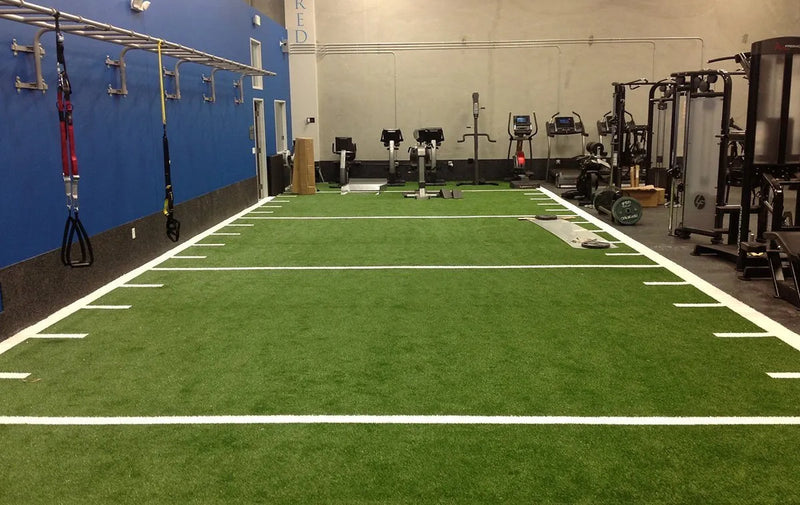
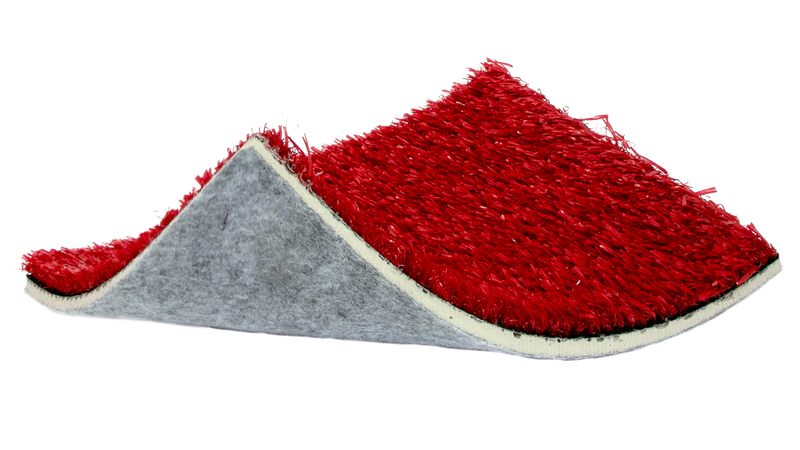
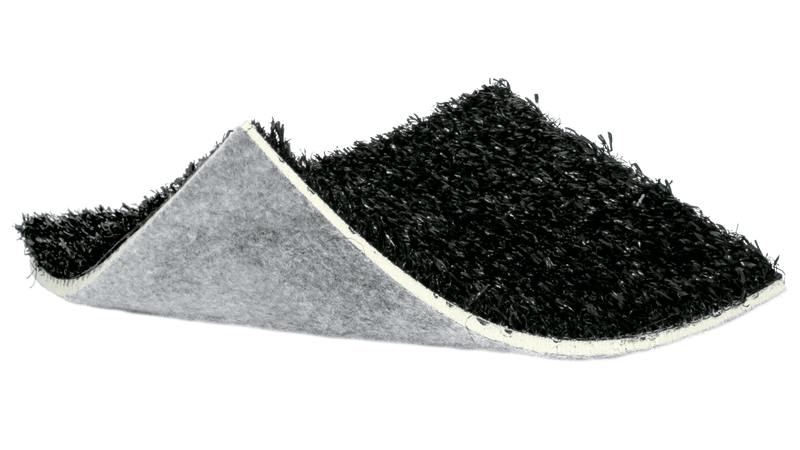
Indoor training turf is a popular choice for gyms, performance centers, and functional fitness spaces looking to create a more athletic training environment. Designed for speed work, sled training, HIIT circuits, and conditioning workouts, this padded turf surface helps support athletes during high-impact training while adding a clean, professional look to your facility.
Features & Benefits:
• No rubber infill required
• Soft, grass-like texture
• Shock-absorbing foam backing
• Durable surface for repeated training use
• Supports multi-sport training applications
• Resistant to abrasion from sled work
• Low-maintenance surface
• Compatible with custom branding applications
Warranty
• 5 year warranty
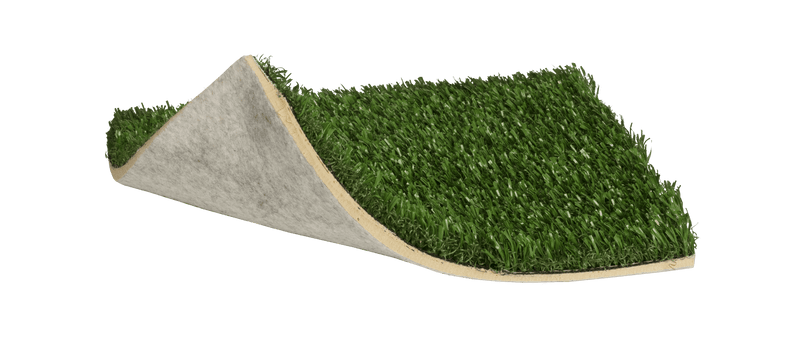
This non-infilled gym turf uses a dual fiber blend of polyethylene and nylon to create a surface that looks and performs more like natural grass while remaining durable enough for daily training. The 5 mm foam backing adds cushioning underfoot to help support comfort during agility drills, bodyweight exercises, stretching, and conditioning sessions.
The durable fiber system is built to handle repeated sled pushes and pulls, functional fitness workouts, and high-traffic gym use. Because the turf does not require rubber infill, cleanup and maintenance are simpler compared to traditional turf systems.
Its versatile design makes it a strong fit for gyms, sports performance facilities, rehab centers, indoor training lanes, and home gyms. The surface also supports custom branding applications for training facilities that want a more professional appearance.
Recommended Uses:
• Functional fitness training
• Speed and agility drills
• HIIT workouts
• Sled push and pull training
• Strength and conditioning areas
• Physical therapy and rehab centers
• Indoor sports facilities
• Home gyms
Product Details
• Non-infilled dual fiber turf system
• 5 mm foam padding with scrim backing
• Yarn Type: 52% Polyethylene / 48% Nylon
• Roll Length: 15 ft
• Pile Height: 3/4 inch
Colors:
• Green
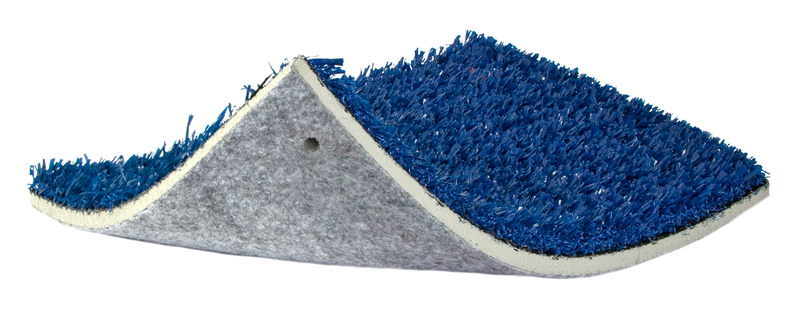
• Blue
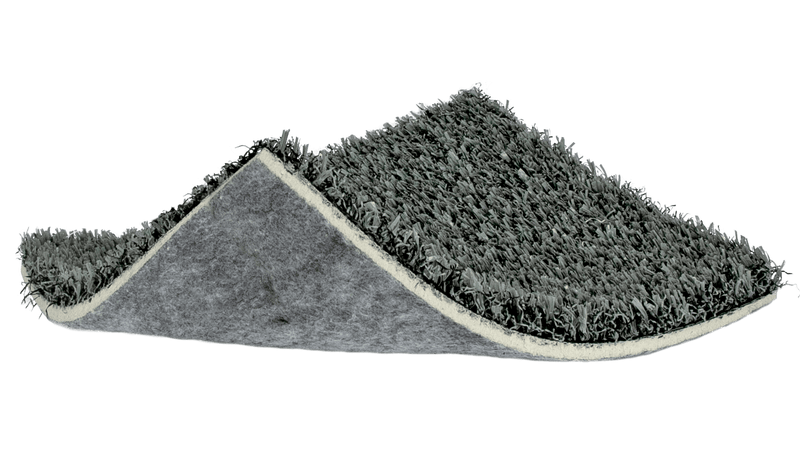
• Black
• Red
• White
• Orange
What is the Living.Fit Indoor Turf made of?
It's a non-infilled dual-fiber turf system with a yarn blend of 52% polyethylene and 48% nylon, mounted on a 5 mm foam backing with a scrim layer. The polyethylene gives it the grass-like feel and slide for sprint and sled work, while the nylon adds the abrasion resistance you need for repeated sled passes and high-traffic training. Pile height is 3/4".
Does this turf need rubber infill?
No. This is a non-infilled system, which means no rubber crumb to track around your gym, no top-up maintenance, and no mess on equipment or shoes. The fiber blend and foam backing are engineered to perform without infill.
Is it padded enough for floor work and bodyweight training?
Yes. The 5 mm foam backing provides shock absorption for HIIT, agility drills, plyometrics, stretching, and core work directly on the turf. If your priority is pure sled performance with maximum power transfer, an unpadded turf will feel firmer — but a padded turf like this is the right call for a multi-purpose training zone where you also want comfort for ground work.
Can I push sleds on it?
Yes — sled push and pull training is one of the primary use cases. The nylon content in the yarn blend is specifically there to resist abrasion from repeated sled work. Most sleds work well on turf; sleds with wider, flatter skids will glide more smoothly than ones with narrow or sharp runners.
How wide are the rolls? Can I order a custom length?
Rolls are 15 ft wide — that's the minimum width and turf is priced in complete 15 ft cut blocks to reduce waste. You can choose a recommended length or enter a custom length on the product page. We recommend adding 10% overage to your square footage calculation to give yourself room for trimming and fit.
What sizes do I need for a sled or sprint lane?
For most home and commercial setups, a usable sled or sprint lane runs between 30 and 100 feet long. Shorter lengths (15–30 ft) work for sled pushes and acceleration drills in tighter spaces. 50+ ft gives you room for longer sustained sprints. Width is set by the 15 ft roll, which you can keep full-width as a training zone or trim down to a narrower lane.
What colors are available?
Green, Blue, Black, Red, White, and Orange. (Note: the white paint striping shown in product photos is not included.)
Where is it made?
The United States.
What's the warranty?
5-year manufacturer warranty. With proper use and maintenance, most customers see a usable life well beyond that.
Can I install this over concrete? Over carpet? Over existing flooring?
Yes to a clean, level, dry concrete subfloor — the most common install surface. It can also be laid over hard, flat surfaces like existing tile or sealed wood. We don't recommend installing directly over carpet or padded surfaces, since the soft base under the foam backing creates instability and accelerates wear at seams.
Do I need to glue it down? Use tape?
For most home gym installations, tape or glue isn't required — the weight of the turf and friction with the subfloor hold it in place. For high-traffic areas, multi-roll seams, sled lanes, or commercial gyms, we recommend either double-sided tape (perimeter for light use, grid pattern for heavy use) or flooring adhesive. Use pressure-sensitive adhesive if you want the option to reposition, or urethane adhesive for a permanent commercial-grade bond.
How do I clean it?
Vacuum regularly to keep debris out of the fibers — any standard vacuum works since the pile is short and tight. For deeper cleaning, use a turf cleaning agent with water. If fibers start to look matted in high-use lanes, a stiff-bristled broom (not wire) brings the pile back upright.
What shoes can I wear on it?
Almost any athletic shoe is fine — running shoes, training shoes, lifters, even cleats with short studs. Avoid long spike track shoes, which can puncture the foam backing.
How is it shipped?
Turf ships via freight delivery only because the rolls are heavy and bulky. Customers must be able to hand-unload the rolls from the truck. Plan on having at least two people available — turf rolls weigh enough that single-person unloading isn't safe or practical.
Is this a stock item or made-to-order?
Turf is cut to your specified length, which makes it a made-to-order product. Some product listings note pre-order status when stock is being replenished — check the add-to-cart section on the page for current status.
What's the return policy?
30-Day Money Back Guarantee in the US, with conditions: the product must be in original packaging, in "as-new" resellable condition, and cannot have been installed. Return shipping is the customer's responsibility, and an RMA number is required before returning. Custom-cut, made-to-order, and special-order flooring may have restrictions — contact customer service at 844-524-0677 or info@living.fit to confirm your specific order qualifies before installing.
Can I add custom branding or logos?
Yes. The surface supports custom branding applications for training facilities that want a more professional look. Contact Living.Fit before ordering to discuss layout, color, and lead time for branded turf.
How does indoor turf compare to rubber flooring?
Different jobs. Rubber gives you drop protection and grip for free weights, lifting platforms, and dropping bumper plates — but pushing a sled on rubber generates heavy friction that wears out both the rubber and your sled skis. Turf is the right surface for sled lanes, sprint work, agility drills, and conditioning zones. Most well-designed gyms use both: rubber under the rack and free weights, turf for the conditioning lane.
1. Prep your surface. Install over a proper subfloor — compacted gravel, concrete, or other hard, level surface available at your location. The subfloor must be clean, dry, and free of debris before you start.
2. Unroll and inspect. Unroll the turf in the general area of the installation. Inspect the full roll for any defects before cutting or seaming. If you find anything, stop and contact us right away at info@living.fit so we can determine the right next step.
3. Trim the edges. Trim the outside beads (the roll edge) to give yourself a clean, uniform edge for installation. Cut from the back of the turf with a fresh utility blade and straight edge — two light passes beat one deep cut.
4. Cut your seams to fit. Where two rolls meet, trim each edge so the seam butts together tight, with no gap and no overlap.
5. Lay seaming tape. Roll out approved seaming tape along the underside of each seam line.
6. Apply adhesive and seam the turf. Bond the seam using an approved turf adhesive. Let the adhesive cure fully before walking or training on the seam — cure time varies depending on the adhesive and your room temperature and humidity. Check the adhesive manufacturer's spec.
7. Inspect the seams. Confirm the adhesive and seam tape have cured properly before moving on. Seams should be tight, flat, and fully bonded with no lifted edges.
8. Broom the surface. Use the appropriate groomer or power broom for the size of your project to lift the fibers upright. For smaller home installs, a stiff push broom works — brush against the grain.
9. Skip the infill. This is a non-infilled turf system, so no rubber crumb or sand is needed. (Standard manufacturer installs include an infill step — yours does not.)
10. Roll the surface. Roll the turf with an appropriate floor roller until you get the finish you want. This presses out air, settles the foam backing against the subfloor, and locks the seams in place.
11. Final inspection. Walk the full surface and check seams, edges, cutouts, and the field for bubbles or lifted areas. Don't move heavy equipment onto the floor until the install is fully cured and inspected.
Note: These steps are a guide. Every install site is different — always account for your specific subfloor, room conditions, and use case before and during installation.
Need help? email info@living.fit.
Routine cleaning
Vacuum the turf as you would any carpet to pick up surface soil. Run a standard vacuum across the full surface — turn off the beater bar or set it to its highest setting, since the short, tight fiber doesn't need aggressive agitation. Do not use a rotary brush machine.
For high-traffic lanes
Brush sled paths and sprint zones against the grain with a stiff push broom to lift matted fibers back upright.
Stain removal — act fast
The polyethylene and nylon fiber blend is resistant to stains, but spills do happen. Remove stains as soon as possible. In most cases, detergent suds or a solvent-based cleaning agent will lift the stain. Use just enough fluid to flush solid particles out of the fiber — too much fluid leaves a ring. Always clean from the outside of the stain inward toward the center to keep the ring from forming.
Stain removal chart
Water-based and common stains — acid, alcohol, animal urine, alkali, blood, coffee, tea, cola, soot, chocolate, dye, glue, fruit juice, ice cream, latex paint, milk, mustard, rust, watercolors
→ Sponge with detergent suds and cold water. Effective even up to 24 hours after the spill.
Chewing gum → Spray with Freon aerosol or freeze with ice, then scrape off.
Crayon → Sponge with dry cleaning solvent.
Nail polish → Sponge with acetone.
Lipstick → Sponge with dry cleaning solvent.
Metal polish → Sponge with dry cleaning solvent.
Furniture stain → Sponge with dry cleaning solvent.
Tar → Scrape off the excess, then sponge with dry cleaning solvent.
Oil paints → Blot immediately. Sponge with turpentine or paint remover. Blot with detergent and water. Re-sponge with cold water to remove the detergent.
Cosmetics, ink, shoe polish → Sponge with detergent and cold water. Apply solvent. Clean the solvent residue with soap and water. Re-sponge with cold water to remove the detergent.
You may need to repeat any of these steps to fully clean the stain.
What to avoid
- Rotary brush machines — too aggressive for the fiber.
- Long-spike track shoes — they puncture the foam backing.
- Dropping bumper plates or heavy weights directly on turf — use rubber flooring or a platform in your drop zone.
- Hot equipment sitting directly on the surface.
- Steam cleaners and pressure washers — too aggressive for the foam backing.
- Bleach and harsh chemicals — they break down polyethylene and nylon fibers.
All purchases accumulate points which be can used to redeem for discounts on all items in our rewards collection. Enroll or view your current rewards balance here.
- Earn 40 points for every $1 spent equaling 5% cash back
Applies to the following products:
- Interlocking tiles
- Rolls
- Turf
We offer a 30-Day Money Back Guarantee to all our customers in the United States. This guarantee is designed to ensure your complete satisfaction, allowing you to return your product for any reason within 30 days of delivery. We’ve made the process simple and straightforward for you. Here’s what you need to know:
How to Qualify for a Refund:
- The product must be returned in the same condition as it was when you received it.
- Your refund request must be submitted within 30 days of the original delivery date.
- You can request a refund by contacting us toll-free at 844-524-0677, through CHAT, or via email at info@living.fit. Our friendly customer support team is ready to assist you and explain your options.
- Please note that the product cannot be returned if it has been installed, removed, and then sent back. Your order must be in its original packaging and in “as new” and resellable condition, just as it was when it first arrived at your location.
- To proceed with a return, contact us to obtain an RMA (Return Merchandise Authorization) number and the return address. You will also need to schedule pick-up and shipping with the carrier of your choice, as you are responsible for all return shipping costs.
- Make sure to include the assigned RMA number on the return shipping labels.
- Once we receive your returned product, we will conduct a quality inspection. Refunds are typically issued within 3-7 business days after the product is received at our warehouse in good, resalable condition. This guarantee applies to all products in the Living.Fit family.
Please note: This policy does not cover custom-made, made-to-order, or special-order products, including clearance items, overstock, discontinued items, kits, underlayment, and all sundries (such as flooring adhesives, moisture control products, TWP, decking fasteners, trims, and moldings) unless the product is defective. Due to the natural characteristics of flooring, slight variations in color and thickness may occur. We cannot accept returns for color and thickness variations unless the thickness is off by more than 1 mm or if the colors are substantially different. Some manufacturers have a minimum quantity requirement for returns and/or may not waive restocking fees. Please contact us to confirm if your product/order qualifies for our 30-Day Money Back Guarantee.
At Living.Fit, your satisfaction is our top priority. Please don’t hesitate to contact us through CHAT or via email at info@living.fit to speak with our customer support team, who will be happy to assist you.
Cancellation & Exchange Options Our goal at Living.Fit is to provide you with the easiest shopping experience and the fastest lead times in the industry. We will do our best to accommodate any changes to your order. Please note that many of our floor products ship the same or next business day, so if your order is already in production, has started the shipping process, or has shipped, we may not be able to make the desired change without additional fees.
How Much Double-Sided Tape You Need for Turf
Tape and glue are not required for most home use. Use double-sided tape to help keep rubber flooring under your turf in place, especially on smooth surfaces or in high-traffic areas where slippage or movement is a concern.
-
Perimeter Only (light use):
- Tape the outer edges only.
- Use ~1 foot of tape per foot of room perimeter.
- Example: 10'x10' room = 40 ft of tape.
-
Perimeter + Cross Strips (medium use):
- Add tape strips across the floor every 3–4 ft.
- Example: 10'x10' room = ~70 ft of tape.
-
Grid Style (heavy use, gym equipment):
- Create a full grid every 2–3 ft in both directions.
- Example: 10'x10' room = 140+ ft of tape.
Quick Estimate by Room Size
- 100 sq ft: Light: 40 ft · Medium: 70 ft · Heavy: 140 ft
- 200 sq ft: Light: 60 ft · Medium: 100 ft · Heavy: 200 ft
- 400 sq ft: Light: 80 ft · Medium: 140 ft · Heavy: 280 ft
Pro Tips
- Tape comes in 25 ft, 50 ft, or 100 ft rolls — round up.
- Use tape made for rubber flooring and your subfloor type.
- Let flooring sit in the room for 24 hours before taping.
How Much Flooring Adhesive You Need for Turf
Tape and glue are not required for most home use. If you're using flooring adhesive instead of tape, it's important to apply the correct amount based on the surface area and type of installation—full glue-down or perimeter-bond.
-
Perimeter-Bond Installation (light to medium use):
- Apply adhesive only around the edges of each tile or roll.
- Best for home gyms or spaces without heavy equipment.
- Requires less adhesive overall—roughly half the amount of a full glue-down.
-
Full Glue-Down Installation (heavy use or commercial):
- Adhesive is applied across the entire surface area.
- Ideal for high-traffic zones or rooms with heavy equipment.
- Provides the most secure bond but requires more product and prep time.
-
Adhesive Types:
- Use pressure-sensitive adhesive for easier repositioning.
- Use urethane adhesive for permanent, high-performance bonds.
- Follow manufacturer guidelines for trowel size and spread rate.
Quick Estimate by Coverage
- 1 gallon (128 oz): Covers ~150–200 sq ft (full coverage)
- Perimeter-bond: Covers ~250–300 sq ft per gallon
- Rolls & sheets: May require more adhesive depending on thickness
Pro Tips
- Always clean and dry the subfloor before applying adhesive.
- Use the correct trowel notch size for your adhesive type.
- Let adhesive cure fully before moving equipment onto the floor.